Amine Corrosion
General Information
Removal of acidic compounds (H2S, CO2, COS etc.) from hydrocarbon streams, both liquid and gaseous, is a critical aspect of refinery operations. The purification of hydrocarbon streams from acidic compounds is commonly achieved through the absorption-desorption process, employing various alkanolamine-based solvents.
Figure 1 illustrates a typical amine unit configuration with a simple absorber/contactor – regenerator setup. However, variations of this arrangement are also possible, depending on factors such as treatment type, the solvent used, or the type/concentration of acid compounds.
 [2](#reference2) [3](#reference3)](/img/amine%20corrosion/Amine%20Corrosion_Figure%201.drawio.svg)
The following are four amine solvents predominantely used in sweetening units:
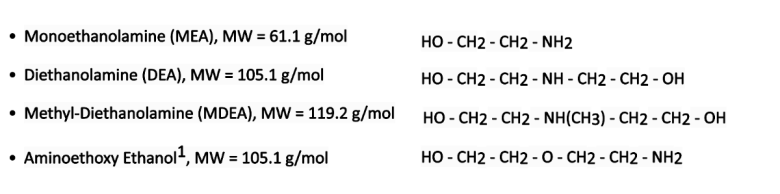
It’s important to mention that, in addition to standard solvents, there exists a diverse range of proprietary amine mixtures and physical solvents. These formulations are typically constructed using conventional solvents or their mixtures, incorporating proprietary additives or newly developed chemicals to achieve specific absorption/selectivity/stability properties of the final solvent. However, solvents of this specialized nature are beyond the scope of this chapter.
Each amine possesses specific properties for the selective absorption of CO2, H2S and other gas contaminants like COS or CS2. In general, the overall process is based on a reversible reaction between the amine (base) and the respective acidic species, as illustrated in simplified Equation 1-4.
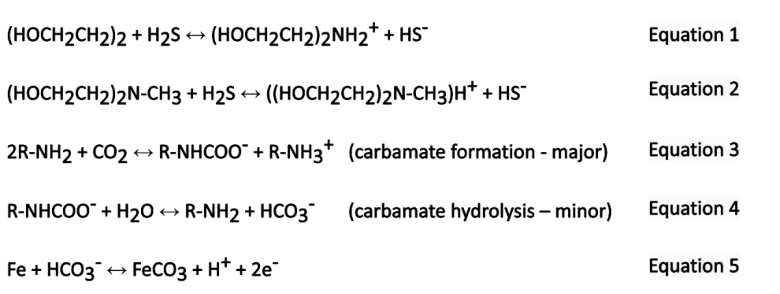
These and other reactions have implications for the corrosiveness of the amine solution. For example, increasing the amine concentration and CO2 gas loading will inevitably lead to a higher concentration of HCO3-, which triggers the corrosion reaction, as illustrated in the example Equation 5.
Since the equilibrium of reversible reactions is dependent on temperature and concentrations of individual species (with pressure playing a negligible role in the given system), it is imperative to maintain specific process temperatures, amine concentrations, and acid gas loadings to minimize solvent corrosiveness. Table 1 provides examples of widely used solvents, along with their typical maximum loads for rich and lean streams.
Table 1 Popular solvents, typical concentration ranges, max loads and other information. 3 4 5 6
| Solvent | Type | Selectivity & properties | Conc., wt.% | Rich load, mol/mol | Lean load mol/mol | Reboiler T, °C |
|---|---|---|---|---|---|---|
| MEAi | Primary | Not removing COS & CS2 | 15-30 | 0.30-0.45 | 0.10-0.15 | 115 |
| DEA | Secondary | Partly removing COS & CS2 | 20-30 | 0.40-0.70 | 0.05-0.08 | 118 |
| MDEA | Tertiary | H2S selective | 50-55 | 0.45-0.50 | 0.004-0.01 | 121 |
| DGA®ii | Primary | Removing COS & CS2 | 40-60 | 0.30-0.40 | 0.1 | 127 |
To find out more information about Amine Corrosion and impact of various parameters register for free or buy a subscription.
Tools
Below are our user-friendly calculators and integrity tools to estimate amine corrosion of carbon steel and selected CRAs.8
Register for Free Trial or upgrade your subscription.
Amine-Corrology®
Amine-Corrology® is designed to provide rapid corrosion rate estimates for carbon steel and stainless steels in amine service. It comprises a dedicated flow modelling engine, which allows you to evaluate the impact of flow parameters like Wall Shear Stress (WSS) and velocity on corrosion rates.
NOTICE: The provided tool is for advisory purposes only. Corrology Innovations Limited and its employees shall not be held liable for any damages, resulting from the use or inability to use the information provided.
Note: Calculation results are currently hidden. Register for Free Trial to unlock Corrosion Rate and Service Life Results.
Integrity Risk Indicator (Corrology®-IRI: Amine)
The Challenge: Moving Beyond Linear Estimates
In amine service, traditional linear corrosion tracking often fails to capture the rapid transition to accelerated damage. As wall thickness decreases, risk does not grow steadily - it accelerates exponentially. Small changes in amine type, concentration, HSAS levels, or temperature can also shift equipment from a stable operating window into a severe-corrosion regime.
The Solution: The Amine Integrity Risk Indicator (IRI-Amine)
The IRI-Amine quantifies asset risk by calculating corrosion rates, service-life context, and remaining-life indicators through a margin-aware, API 581-inspired engine. This tool functions as a sensitivity analysis engine, allowing you to evaluate how shifting amine concentration, temperature, HSAS levels, flow velocity, and inspection evidence impact carbon steel and Corrosion Resistant Alloys (CRAs) across both Predictive and Inspection workflows.
This score should be interpreted as an integrity / probability-of-failure-style indicator. It is not a full API RBI risk result in the sense of likelihood × consequence, because consequence-of-failure is not part of this score.
The Advantage
Access a high-speed, agile modeling engine designed for rapid, defensible engineering decisions:
Non-Linear Risk Scaling: Utilize a logarithmic-exponential transformation that reflects the true physical reality of risk escalation in late-life degradation states.
Dynamic Inspection Credit: Input your Inspection Effectiveness (Class A-E) to see how higher-quality inspection evidence reduces conservatism in the Bayesian risk calculation.
Auto-Derived Prior Confidence: Prior confidence is automatically computed from the uninspected time interval (tuncertainty): <3 years = High, 3-5 years = Medium, >=5 years = Low. This applies in both Predictive and Inspection modes and remains read-only in the standard UI workflow; API and integration callers may pass priorConfidenceOverride or priorConfidence when an explicit override is required.
Precision Structural Floors: Take control of your model by setting Manual T-Min structural floors to match your equipment’s unique geometry.
Expert Calibration: Gain confidence with a model structured against a 6-point lifecycle truth set, ensuring accuracy from low-risk early life to critical thin-wall scenarios.
API 581-Aligned Risk Bands: Status and score-pill color are determined by the log probability of failure (log Pf) rather than the 0-100 score scale alone. For observed unrepaired amine cracking, the operator-facing Carbon Steel result is treated as an FFS hard stop and is intentionally shown without risk score or remaining service life until FFS disposition is complete.
Note: The Integrity Risk Indicator (IRI-Amine) shown below is a static preview of our Professional+ engine. Register for Professional+ to unlock IRI-Amine.

References
Paid Subscribers can have access to the list of references.
- i- Parameters like max loading and concentration will depend on several factors like presence of H2S, inhibitors etc.
- ii - Aminoethoxy ethanol known by trade names DGA® or Diglycolamine® which are registered trademarks of Huntsman Corporation.